
Most stress doesn't announce itself. By the time you notice the headache, the racing heart, or the wave of overwhelm, your nervous system has already been waving smaller flags for hours. You just learned to walk past them.
These are the small signals that show up before the tension builds. The ones you've normalized, ignored, or never had words for. Once you know what to look for, your body becomes a kind of early warning system you can actually trust.
Why the Small Signals Matter
Your nervous system is constantly scanning for safety. When something feels off (a tense email, a difficult conversation, an unspoken expectation), it starts preparing your body to respond before your conscious mind has even processed what's happening. The big symptoms come later. The tight chest, the headache, the wave of fatigue. By the time those arrive, you're already deep in a stress response.
The small signals come earlier. They're your body whispering. And the value of learning to hear them is that you can interrupt the pattern before it builds, instead of trying to recover from it after.
What follows is a list of subtle cues that tend to show up first. Most of them are quiet, easy to miss, and things you've done thousands of times without noticing. Once you start tracking them, you'll begin to see your own patterns, and that awareness alone changes how your nervous system responds.
The goal of noticing these signals is to build a relationship with your body, so you can catch tension earlier, when it's still soft enough to release without much effort. Awareness comes first. Everything else follows from there.
The Small Signals
Read through these slowly. As you go, notice if any of them feel familiar. You don't need to do anything with the recognition. Just let it land.
The Unconscious Sigh
You let out a long exhale and didn't realize you were holding anything in. It often happens when you sit down, when you finish a task, or when you finally have a moment alone. The sigh is your nervous system trying to discharge tension that built up while you weren't paying attention.
Most people sigh several times a day without registering it. The pattern matters because the sigh itself is a clue: your body just released something it had been holding. If you notice yourself sighing, pause for a second and ask what came right before it. That's usually the trigger.
Holding Your Breath Without Realizing
You're scrolling, reading an email, focused on a task, and suddenly you notice you haven't taken a real breath in a while. There's a phrase for this called "screen apnea" or "email apnea," and it's incredibly common. Your breath gets shallow or stops entirely when you're concentrating, anticipating something, or absorbing information that feels even slightly stressful.
The signal is the moment you remember to breathe, almost with a small gasp. That gasp is your body correcting for the breath it forgot to take. It often happens 20 to 30 times a day for people who work on screens.
Touching Your Throat or Chest
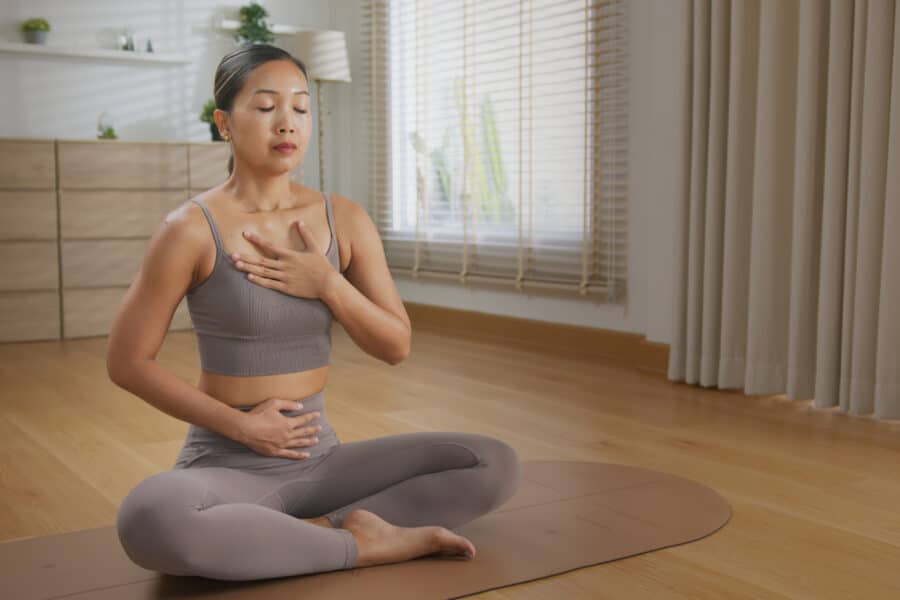
Your hand drifts up to your collarbone, your throat, or the center of your chest. Maybe you rest it there. Maybe you press lightly. Often it happens during difficult conversations, when you're reading something upsetting, or when you're trying to find words and can't.
This is a self-soothing gesture your nervous system reaches for instinctively. The throat and chest are where the vagus nerve runs closest to the surface, and gentle touch in these areas sends calming signals to your brain. Your body is asking for grounding, and your hand is providing it before you even think about it.
Clenching Your Jaw Between Sentences
This is different from full-on jaw clenching. It's the small, almost invisible tightening that happens between words, between thoughts, in the pause before you speak. Your back teeth come together. Your tongue presses against the roof of your mouth. The masseter muscle along your jawline holds for a fraction of a second longer than it needs to.
You can test this right now. Where is your tongue? Are your back teeth touching? If yes, your jaw is holding something. This pattern is especially common during conversations where you're managing your reactions, choosing your words carefully, or holding back what you actually want to say.
Mouth Breathing Instead of Nose Breathing
At rest, your mouth should be closed and you should be breathing through your nose. But under stress, even mild stress, many people unconsciously shift to mouth breathing. The mouth opens slightly. Breaths get shallower. Your tongue drops from the roof of your mouth.
You might notice this most when you're focused, anxious, or trying to appear calm in an uncomfortable situation. Mouth breathing keeps your body in a low-grade activation state because nose breathing is what tells your nervous system you're safe. The fix is small but powerful: notice, close your mouth, and let your tongue rest gently against the roof of your mouth.
Tension Behind the Eyes or Frequent Blinking
This one is subtle because most people never think about their eye muscles being tense. But your eyes are surrounded by tiny muscles that respond to stress just like your jaw or shoulders do. It can feel like a dull, heavy pressure behind your eyeballs, almost like someone is pushing them gently from behind. There might be a tight band across your forehead or between your eyebrows that you didn't notice until you touched it.
Other signs: eyes that feel "tired" even when you've slept enough, the urge to close them or press on them with your fingertips, or fast blinking you don't realize you're doing. The frequent blinking is interesting because it's often a self-soothing mechanism. Your nervous system blinks more rapidly to try to discharge built-up tension, and people also tend to blink more when they're holding back an emotional reaction. If you notice yourself blinking quickly during a hard conversation, that's the signal.
A Tight Belly You Didn't Notice Until Now
This one is tricky because most people walk around with chronically held abdominal muscles and have completely normalized it. They don't know their belly is tight because they've never felt it soft. Your belly feels "pulled in" or held slightly flat even when you're not consciously sucking it in. When you try to take a deep breath, your belly doesn't expand. Only your chest rises.
Here's a quick test: take a slow breath in through your nose right now and notice where it goes. If your chest and shoulders rose but your belly stayed still, your abdominal muscles are held. Most people are genuinely surprised the first time they realize their belly hasn't moved when they breathe in months or years.
A chronically held belly is your body bracing. It's a protective pattern that often develops during prolonged stress and becomes so baseline you stop registering it. When you finally notice it and try to soften, it can feel strange, almost vulnerable, like you're letting your guard down. That feeling is information.
Your body has been speaking this whole time. Now you have words for what it's been saying.
What to Do When You Notice One
The first thing to know is that noticing is the practice. The moment your awareness lands on a small signal, you've already shifted out of autopilot, and that shift alone begins to change how your nervous system responds.
That said, there are a few simple things you can do in the moment that build on the noticing:
Name what you noticed. Out loud or silently. "My jaw is tight." "I'm holding my breath." Naming activates a different part of your brain and creates a small gap between you and the pattern.
Take one slow breath. Not five. Not a whole breathing exercise. Just one breath, slightly longer on the exhale than the inhale. This signals safety to your nervous system without making the moment feel like a project.
Soften the area. Whatever is tense, see if you can let go of just a little. Drop your shoulders an inch. Unclench your jaw. Let your belly expand on your next breath. You don't have to release everything. Just notice what happens when you offer yourself a small amount of space.
Move on without judgment. The point is to build a habit of catching these signals earlier, more often, with less reactivity. Every time you notice and let go a little, you're teaching your nervous system that it has options.
These small signals are your body offering you information in the only language it knows. The more you listen, the more it tells you, and the easier it becomes to come back to yourself before tension turns into something bigger.
The "I Can't Relax" Toolkit
Four micro-exercises that work with the small signals your body sends. Designed for the moments you notice tension but don't have time for a full practice.
Get the ToolkitFrequently Asked Questions
What if I notice these signals all the time?
If most of these feel familiar, your nervous system has likely been running in a low-grade activation state for a while. That's worth paying attention to, but it's also extremely common. Start with one signal at a time. Pick whichever one stands out most and just track it for a week without trying to change anything. Awareness is the first ingredient in any nervous system shift.
Can these signals mean something other than stress?
Sometimes. A tight belly could be related to digestion. Frequent blinking could be from screen fatigue or dry eyes. Mouth breathing could be a structural issue. If any of these signals are persistent or accompanied by other physical symptoms, it's worth checking in with a doctor. The goal of this post is to help you notice patterns, not to replace medical guidance.
How long does it take to start noticing these on my own?
Most people start catching at least one or two within the first few days of reading a post like this. The brain primes itself to look for what you've recently learned about. Within a couple of weeks of casual attention, you'll likely be noticing several throughout your day without trying.
Is it normal to feel emotional when I notice these?
Yes. Sometimes the act of noticing chronic tension brings up emotion, especially when you realize how long you've been holding something. That's a sign your body is starting to feel safe enough to let you in. Let the emotion move through without trying to analyze it.
Want to stay connected to this work?
I share weekly essays, gentle tools, and quiet insights to support your healing.
No spam, ever.
Unsubscribe anytime. Your peace matters more than my list.
Want to stay connected to this work?
I share weekly essays, gentle tools, and quiet insights. No spam, ever.
Unsubscribe anytime. Your peace matters more than my list.


 Support The Blog