
Most of us learn to handle stress in the head. Name the worry, reframe the thought. That works to a point. The body, though, keeps its own record of stress, and it does not always listen to reason.
You can know a deadline is manageable and still feel your chest go tight. The mind can understand an argument is over while the shoulders keep holding it for hours. That space between what the mind knows and what the body feels is where somatic work begins.
What somatic exercises are
The word somatic comes from the Greek soma, meaning the body. Somatic exercises are small physical practices that work with the body directly, through breath, movement, pressure, temperature, or sound. They give the nervous system a clear physical signal, the kind the thinking mind cannot always provide on its own.
A slow exhale is one example. So is splashing cool water on the face. Practices like these signal to the body that it can come down, which it reads as a sign of safety. If you are new to the idea, this beginner's guide to somatic healing is a gentle place to start.
Why stress stays in the body
When something feels threatening, the nervous system reacts before the thinking brain has caught up. The heart rate climbs and the breath turns shallow. This is the fight-or-flight response, and it is useful when there is a real and immediate danger.
The trouble is that the same response fires for things that carry no real danger. A full inbox can do it. So can a crowded room. The body braces as if it needs to run, and once the moment passes, that bracing does not always release on its own. It can stay in the jaw or the shoulders long after the day is over. When this becomes a pattern, the body can get stuck in a stress state, which you can read more about in 5 signs your nervous system is stuck in survival mode.
Somatic exercises work because the nervous system listens to the body more readily than it listens to logic. A slow exhale or a low hum reaches the vagus nerve, the body's main calming pathway, and gives it a direct signal to bring the heart rate down.
The states the body moves into
Stress does not feel the same every time. Some days it looks like a racing mind and a body that cannot sit still. Other days it looks like the opposite, a heavy fog where getting off the couch feels like too much. The right somatic practice depends on which state the body is in, which is why a single technique rarely fits every moment.
Broadly, the nervous system tends to move through a handful of recognizable states:
Six common states
- ActivatedRacing heart, tight chest, thoughts that will not slow down.
- Shut downHeavy limbs, brain fog, the sense that moving takes more than you have.
- Wired with nowhere to put itRestless, jittery, unable to be still even when the moment has passed.
- OverwhelmedOverstimulated and on edge, with more stacking on top.
- DisconnectedNumb or floating, far from yourself or the room around you.
- Holding tensionA clenched jaw, raised shoulders, a chest that will not fully release.
A different state needs a different response. Cold water helps a racing system, but it would do little for a body that has gone numb, which needs gentle movement to come back to itself. Matching the practice to the state is the heart of working somatically. If you want a few starting points to try right now, here are 5 somatic exercises to calm your nervous system.
Get to know the Somatic Handbook
Knowing that somatic practice helps is one thing. Remembering what to actually do in the moment, when the mind is racing or the body has gone quiet, is harder. The Somatic Handbook was built for exactly that gap.
It is a collection of thirty body-based practices, organized by the six states above, so you can turn to the chapter that matches how you feel and find something to do in a few minutes. Every practice page is built the same way. A line at the top tells you what the practice is for. Then it walks through when to use it, how to do it, and why it works, with a short "when to skip" note that points you to a gentler option if it is not the right fit that day.
A few things that make it easy to actually use:
- Thirty practices across six chapters, each organized by how you feel
- Most take only a few minutes, and many can be done anywhere without anyone noticing
- A journaling page in every chapter to notice your own patterns over time
- Six short sequences that string practices together for specific moments, like a spiraling mind or a tired-but-wired evening
- Fully linked, so you can tap any practice on your phone and jump straight to it
Many people keep it saved on their phone, so they can open it during a stressful day or after a hard conversation, in the moments when the body feels stuck and it is hard to know what to try first.
Your body already knows how to bring itself down. These practices are here to give it a little more support on the harder days, something practical you keep on hand and reach for when the body asks for it.
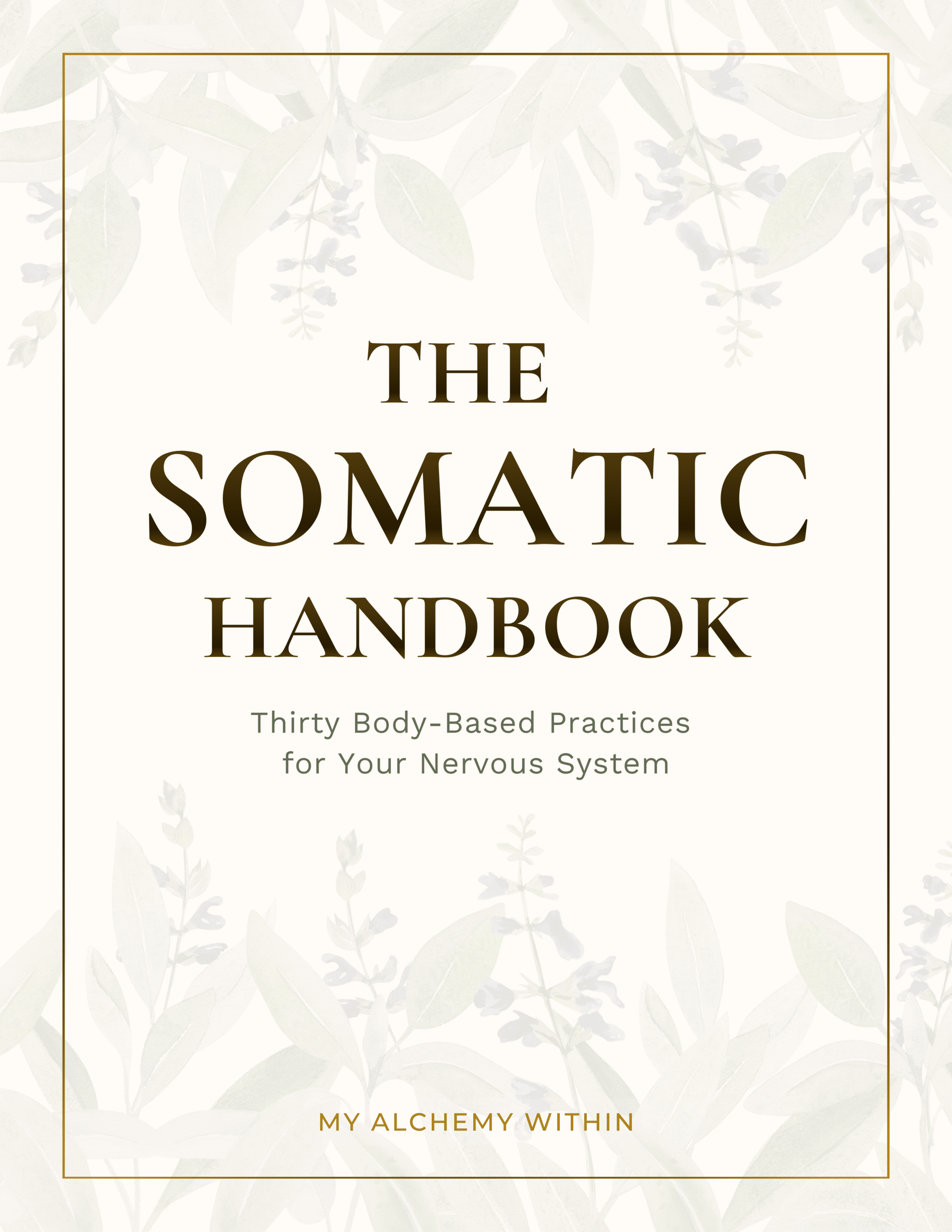
The Somatic Handbook
Thirty practices, sorted by state
Open to the chapter that matches how you feel, and find a practice in a few minutes.
Explore the HandbookCommon questions about the handbook
What's included in the handbook?
Thirty body-based practices across six chapters, each organized by a nervous system state. Every chapter also has a journaling page for noticing your own patterns, and the back of the book holds six short sequences that combine practices for specific moments. It runs 55 pages and arrives as a PDF.
How do I get it after I buy?
The handbook is a digital PDF, so it arrives the moment you check out. You can read it on your phone, keep it on a tablet, or print the pages you reach for most. It is fully linked too, so tapping a practice or chapter jumps you straight there.
What if I've never done somatic work before?
No experience is needed. If you are not sure where to begin, start with Chapter One. The practices there work quickly, often in under a minute, and each page walks you through exactly what to do. You do not need any equipment, and most practices can be done sitting right where you are.
What if a practice doesn't work for me?
That is built into the design. Bodies respond differently, and not every practice fits every person. Each one has a short "when to skip" note that tells you when to pass on it and points you to a gentler practice that may suit you better, so there is always somewhere else to turn.
Why buy this if there are free somatic exercises online?
Free exercises are everywhere, and many of them are good. The hard part is finding the right one in the moment, when the mind is racing or the body has gone quiet and scrolling through articles is the last thing you want to do. The handbook is organized by how you feel, so you open to the matching chapter and have a practice in seconds. You are paying for the structure, and for not having to search in a hard moment.
Keep all thirty practices in one place, sorted by how you feel.
Explore the Handbook


 Support The Blog