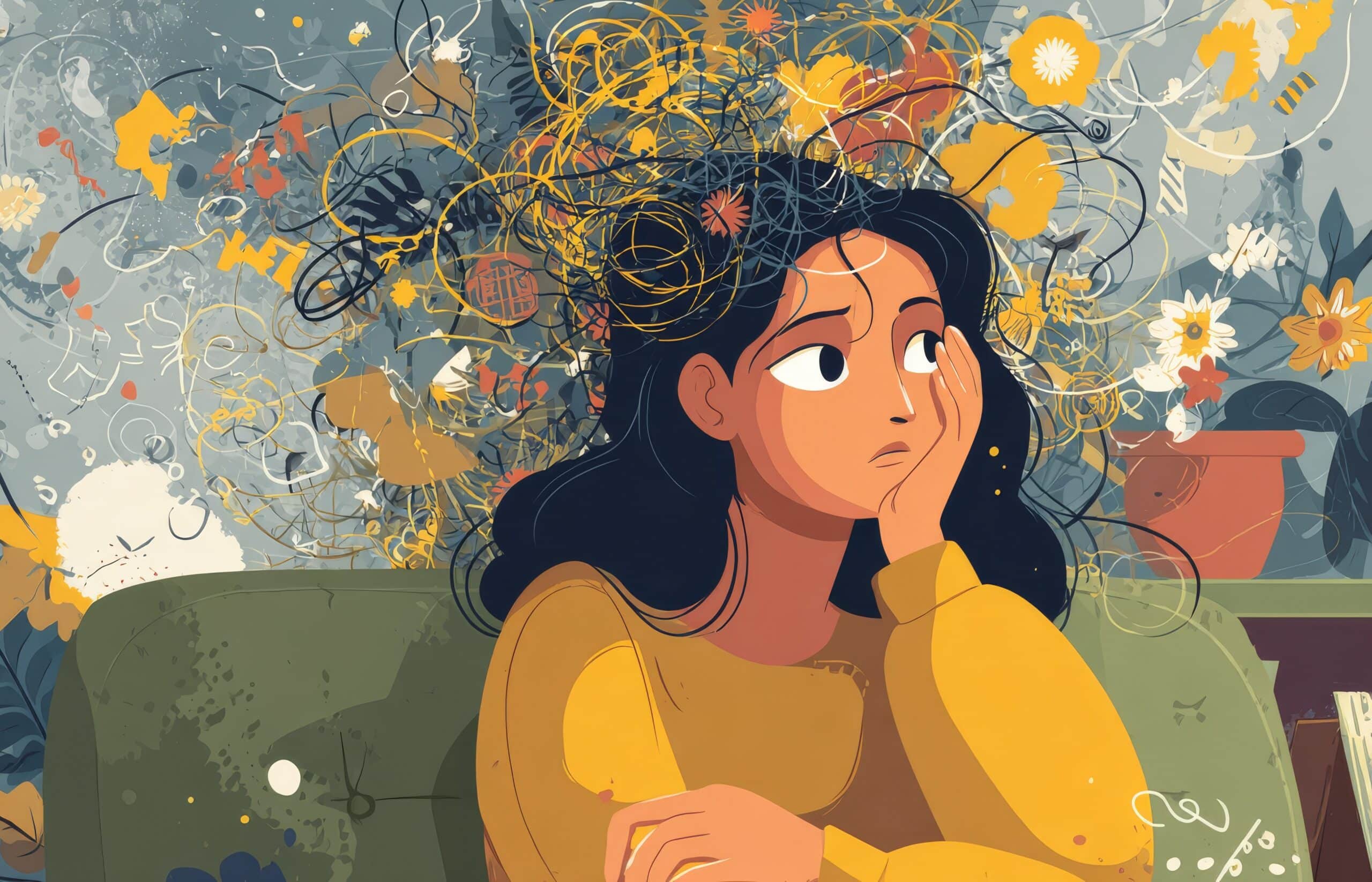
Hours after a conversation ends, the mind can keep running it: something that was said, or the way it might have come across. Here's why the replaying happens, and what helps it stop.
Replaying is the brain trying to close out a social interaction that still feels open. Understanding what the loop is checking for makes it much easier to end.
What the Replaying Looks Like
The pattern is more common than most people who have it would guess, and it takes a few familiar shapes:
- Rerunning something said earlier and wishing a different version had come out
- The perfect reply arriving hours after the conversation ended
- Wondering whether people were put off by something, with no way to check
- Muttering the awkward moment out loud on repeat, sometimes days later
- Old conversations resurfacing years afterward, sometimes all the way back to high school
For some people it's occasional. For others it runs after nearly every interaction, to the point where the replaying takes more energy than the socializing did, and starts to eat the enjoyment of going out at all.
Why the Brain Replays Conversations
Social interactions end without a verdict. A test comes back with a grade, and a work project gets approved or sent back, but a conversation just ends, and nobody tells you how it went. The brain doesn't like open questions about belonging, because being liked and accepted by other people has always mattered for survival. So it does the only thing it can do with an unanswered question: it goes back over the evidence.
The replaying is a review process. The brain goes back over the conversation for signs of how you came across, looking for mistakes it should flag for next time. The problem is what it chooses to review. Brains give far more weight to possible social errors than to everything that went fine, so the loop skips the forty smooth minutes and goes straight to the one sentence that felt off.
What research calls it
Researchers who study social anxiety have a name for this: post-event processing, the mental review that follows social situations. Research on post-event processing has found that it focuses on negative moments, that it can distort the memory of the event toward self-criticism over time, and that more reviewing tends to produce more anxiety about the next interaction, since the review keeps confirming that something went wrong.
That last part matters. The loop presents itself as useful, as if one more pass through the conversation will finally resolve it. But there's no new information to find. The conversation is over, the other person's reaction is unknowable from here, and the replaying can only re-examine what it already has, which is why it can run for hours without arriving anywhere.
Why It Gets Louder at Night
The loop shows up most reliably in one place: lying in bed with the lights off. That's partly about competition for attention. During the day, the replaying has to share space with work and other people, and at night there's nothing else going on, so it gets your full attention.
It's also about what state the body is in. After a social event, the nervous system is often still activated even once you're home, and that leftover activation keeps the mind alert and scanning. Replaying conversations while wide awake and worn out is one of the classic signs of a social hangover, the crash that follows socializing, and the two tend to show up together: the body is drained while the mind won't stop, and the conversation from three hours ago plays one more time.
Is This Social Anxiety?
Sometimes. Post-event processing is one of the core features of social anxiety, and if the replaying comes with heavy dread before events and intense fear of being judged during them, and it's interfering with your life, that's worth bringing to a therapist. Social anxiety responds well to treatment.
Plenty of people replay conversations without having an anxiety disorder, though. It's common in people who care about how they treat others, in people who grew up needing to read rooms carefully, and in people whose nervous systems take in more of every interaction. The habit alone doesn't mean something is clinically wrong. It means an open question got flagged as important.
Why Thinking It Through Doesn't Make It Stop
The natural response to the loop is to engage with it, reasoning through whether the comment was fine and building the case that nobody noticed. Sometimes that works. Often it doesn't, and there's a reason: the replaying isn't only a thinking problem. It's running on a body that's still activated from the event, and an activated body keeps the mind in scanning mode no matter how good the arguments are. You can reason it all the way through and the loop starts over anyway.
That's why the most reliable exits go through the body first and the thoughts second. When the activation drops, the loop mostly stops on its own.
What Helps When a Conversation Keeps Replaying
Give the body an ending. The loop runs on the feeling that the interaction is still open, so close it physically. A long, slow exhale repeated a few times, a warm shower, or steady pressure like a heavy blanket all signal that the event is over. A few of the somatic exercises you can do at home work well here, and they reach the loop faster than debating it does.
Write the moment down once. One honest paragraph about what happened and what you're worried it meant. Putting it on paper tells the brain the moment has been handled, and handled things get rechecked less. Once means once, though. Rewriting it five ways is just the loop again.
Answer the question the loop is asking, one time. Underneath the replaying there's usually a single question, along the lines of "did I upset them" or "do they think less of me now." Name it and give it your most honest answer, then let that answer stand. The loop will offer the question again. It already got its answer.
If it's bedtime, treat it as a body problem. Keep the lights low and the phone away, and give your attention something physical to do, like feeling the weight of the blanket or the temperature of the room. Arguing with thoughts at midnight is a losing game, and giving the body something quieter to process is not.
Notice when it travels with the crash. If the replaying reliably shows up alongside feeling drained and done with people, you're often looking at the recovery phase after socializing, more than a thinking problem, and it may help to treat the whole state, beginning with why socializing takes so much out of some of us in the first place.
The Social Hangover Recovery Guide
A step-by-step guide for the hours after socializing, made for the nights the conversations keep replaying. Name what drained you, follow the recovery routine that matches it, and reset the next morning.
Get the Recovery GuideSources: the concept of post-event processing comes from Clark and Wells’s cognitive model of social anxiety (1995); Brozovich and Heimberg’s review in Clinical Psychology Review (2008) summarizes the research on it.
Lauren Sweeney is the founder of My Alchemy Within, where she writes plain-language, research-informed guides to nervous system recovery. Her work draws on published research and her own lived experience with an easily overwhelmed nervous system. She is not a therapist, and everything here is educational rather than medical advice. More on the About page.
This article is for education and general self-support. It is not medical or mental health advice, and it is not a substitute for care from a qualified professional. If you are in crisis or your symptoms are interfering with daily life, please reach out to a professional.


 Support The Blog