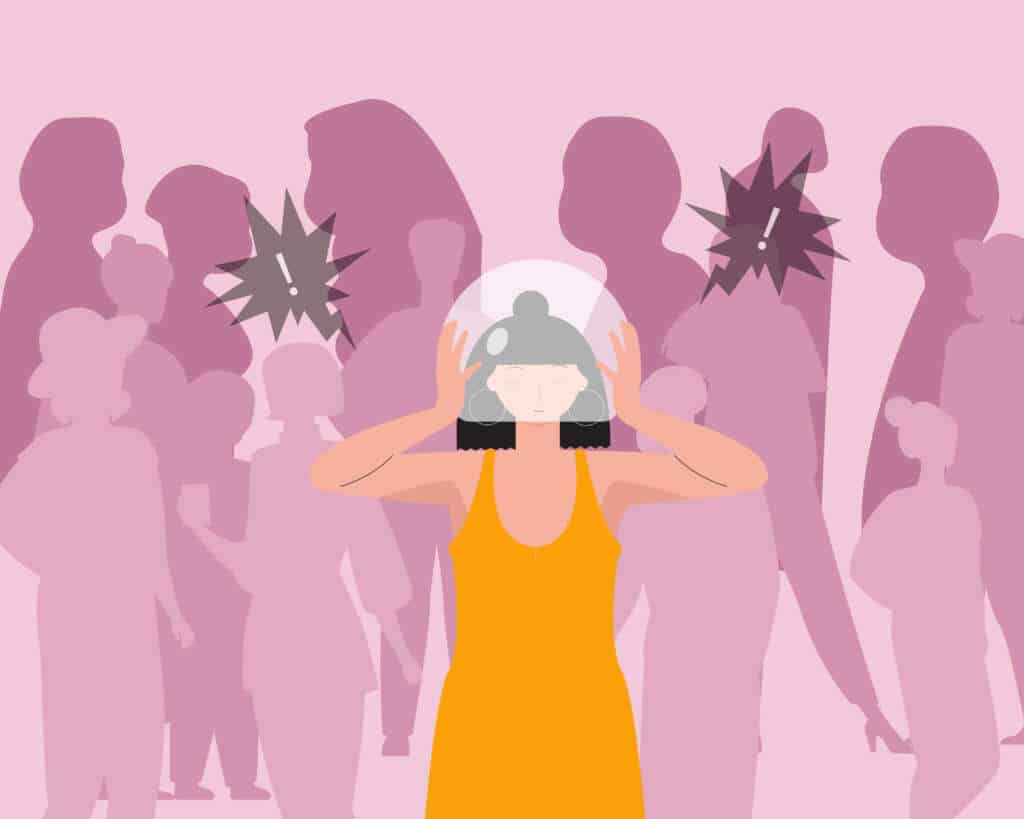
You're sitting at dinner with people you know and like. The conversation is light, nothing's wrong. But somewhere in the background of your mind, there's a running commentary: She seems quieter than usual. Did I say something wrong? He just checked his phone, is he bored? Was that pause weird? Should I fill the silence?
This constant tracking of tone, expression, mood, and micro-signals happens so automatically that you might not even realize you're doing it. It's just how your mind works in social situations. But it's not how everyone's mind works. And it's draining you more than you know.
This is mental scanning: the exhausting habit of monitoring your environment for potential threats, reading between the lines of every interaction, and staying one step ahead of anything that might go wrong. It looks like social awareness on the surface. Underneath, it's a form of hypervigilance your nervous system learned in order to keep you safe. Once useful, now depleting.
I used to think everyone did this. I assumed all minds worked this way, constantly evaluating, predicting, preparing. It wasn't until someone described being fully present in a conversation without simultaneously running background checks on everyone's emotional state that I realized: this was my nervous system doing a job that no one had asked it to do.
What Mental Scanning Actually Is
Mental scanning is the cognitive companion to the body-based neuroception we explored earlier in this series. While neuroception happens automatically at the nervous system level, scanning for physical cues of safety and danger, mental scanning is what happens when your thinking mind gets involved in that same job.
Your autonomic nervous system handles scanning the way it handles breathing. You don't decide to do it. It runs. The mind joins the process and starts narrating: interpreting, analyzing, predicting.
It looks like tracking shifts in tone and wondering what they mean, monitoring facial expressions for signs of disapproval, replaying what you just said and evaluating how it landed, predicting what someone might be thinking or feeling, running through worst-case scenarios before they happen, and rehearsing your responses to conversations that haven't occurred yet.
This is attention working overtime. Your mind is treating every social situation as a puzzle to solve or a threat to manage, rather than an experience to be in.
Signs Your Nervous System Is Scanning on Autopilot
Mental scanning can be hard to recognize because it feels like just paying attention. Here's what it looks like when your nervous system has taken over the job:
- You're often more focused on how you're coming across than on what's actually being said
- You notice subtle changes in people's expressions and immediately interpret them, usually negatively
- After interactions, you replay them in your mind, analyzing what went well and what didn't
- You prepare for conversations in advance, thinking through what you'll say and how they might respond
- You feel like you're performing in social situations rather than just being there
- Small pauses or silences feel uncomfortable and you rush to fill them
- You often know more about how everyone else is doing than how you're doing
- You can sense when someone is tense or frustrated before they've said anything
- Your jaw, shoulders, or breath tighten in group settings without you noticing
These signs often show up alongside other patterns we've covered in this series, including the way your body can absorb other people's moods or leave you drained after socializing with people you love. What looks like being too sensitive or too empathic is often nervous system overload dressed in a personality label.
Why Thinking Your Way Out of Mental Scanning Doesn't Work
The tricky thing about mental scanning is that it feels productive. It feels like you're being careful, responsible, aware. The mind convinces itself that if it just thinks hard enough, analyzes deeply enough, prepares thoroughly enough, it can prevent bad outcomes. But the opposite is usually true.
Scanning doesn't make social situations safer. It makes them more exhausting. It doesn't improve your relationships. It keeps you from being present in them. And most importantly, it doesn't actually reduce anxiety. It feeds it. The more you scan for threats, the more threats you find. The more you analyze, the more there is to analyze. The loop reinforces itself.
This is why you can't think your way out of scanning. Telling yourself to "just relax" or "stop overthinking" doesn't work because the scanning isn't primarily a thought problem. It's a nervous system state. Your body believes it needs to stay alert, so your mind dutifully complies by running surveillance on everything around you.
To interrupt mental scanning, you don't argue with your thoughts. You change what your body is doing. When the body settles, the mind follows.

Tools for Interrupting the Scanning Pattern
The following tools work because they shift your nervous system state, which in turn quiets the mental scanning. These tools don't force you to think differently. They give your body signals that it's safe enough to stand down.
The Anchor Breath
When you notice yourself scanning, tracking the room, analyzing someone's tone, preparing for potential conflict, come back to your breath. Not to control it or change it, but to notice it. Feel the air entering your body. Feel it leaving. Let the exhale be slightly longer than the inhale.
This isn't a breathing exercise in the traditional sense. It's an anchor. It gives your attention somewhere to land that isn't the endless analysis of everyone around you. Even three conscious breaths can interrupt the scanning loop enough to create a pause.
Counter-Hypervigilance
Instead of scanning outward, tracking other people's states, expressions, and moods, deliberately scan inward. Ask yourself: What am I feeling in my body right now? Where am I holding tension? What's my breath doing?
This is counter-hypervigilance: redirecting the scanning energy toward yourself rather than trying to eliminate it entirely. Your mind wants to scan something. Give it something useful to scan. Your own body. Your own experience. What's happening for you, right now, in this moment.
Soft Eyes
When we're in hypervigilant mode, our eyes tend to narrow and dart, tracking movement, reading faces, looking for cues. You can interrupt this by intentionally softening your gaze.
Let your eyes relax. Soften your gaze and allow your peripheral vision to widen. Choose something still in your environment, like a plant, a piece of furniture, or a door frame, and rest your eyes there gently. Stay aware of the space around it without focusing hard.
Physical Grounding
Your body is the fastest route out of mental scanning. When you notice your mind spinning in analysis, drop your attention into physical sensation: the weight of your body in the chair, the feeling of your feet on the floor, the temperature of the air on your skin.
You can also use subtle physical releases: unclench your jaw, drop your shoulders away from your ears, let your belly soften. These aren't dramatic movements. No one will notice you doing them. But they send a powerful signal to your nervous system: I can let go. I don't have to hold everything together right now.
The "Right Now" Check
Most mental scanning is oriented toward the future (what might happen) or the past (what already happened). A simple way to interrupt it is to ask yourself: What is actually happening right now? Not what might happen. Not what someone might be thinking. What is literally, observably happening in this moment?
Usually, the answer is: nothing bad. Someone is talking. I'm sitting here. There's a conversation happening. When you stay with what's actually happening instead of what your mind is predicting or analyzing, the scanning loses its grip.
For the next social situation
The next time you're in a social situation and notice yourself scanning, try this simple sequence.
- Notice. "I'm scanning right now."
- Anchor. Take one slow breath. Feel your feet on the floor.
- Soften. Relax your eyes. Drop your shoulders.
- Return. Come back to what's actually happening. The sound of the voice. The words being spoken. This moment, not the next one.
You won't do this perfectly. You'll scan again. That's okay. The practice isn't about stopping scanning forever. It's about shortening the loop. Noticing sooner. Coming back faster. Over time, this builds a new pattern.
Presence grows when your system learns it has another option.
What Changes When the Scanning Quiets
When mental scanning softens, several things shift. Conversations feel less like work and more like actual connection. You have access to your own thoughts and feelings again, instead of being consumed by everyone else's. Social situations stop being so draining because you're no longer running continuous background analysis.
You become more present, partly because you stop trying so hard. Your system finally settles. Presence is what remains when the vigilance is no longer required.
This shift doesn't mean you become oblivious to other people or stop noticing social cues. You can still be aware of what's happening around you. Awareness and surveillance feel different, though. Awareness is relaxed and receptive. Surveillance is tense and effortful. The tools in this section help you move from the second to the first.
For more on what that shift looks like in the body, you might find the article on when your body feels stressed without your mind helpful, or the foundational piece on somatic healing which anchors this whole approach.
The I Can't Relax Toolkit
If your nervous system stays activated even when nothing is wrong, the I Can't Relax Toolkit offers body-based practices designed for exactly this pattern. A regulation sequence for when your mind won't stop scanning, practical exercises for downshifting out of hypervigilance, and somatic tools you can use in real time when you feel yourself pulled into the loop.
Explore the Toolkit / $9Also available as part of the complete bundle with the After-Socializing Recovery Guide and the Shutdown Mode Recovery Guide.
Frequently Asked Questions
Isn't some level of social awareness normal and healthy?
Yes. Noticing social cues, reading the room, and being attuned to others are all valuable skills. The difference is between awareness (relaxed, receptive, present) and scanning (tense, evaluative, exhausting). Healthy social awareness leaves you energized or neutral. If paying attention to people consistently drains you, the issue is vigilance, not awareness.
What if I can't stop analyzing after an interaction?
Post-interaction analysis, replaying conversations, evaluating what you said, worrying about how you came across, is a common extension of mental scanning. The same tools apply: notice when it's happening, anchor in your body, and gently redirect your attention. It can also help to set a boundary with yourself: "I'm going to think about this for five minutes, then I'm done."
How long does it take to change this pattern?
Mental scanning is a deeply ingrained habit, so it doesn't disappear overnight. Most people find that with consistent practice, the loop starts to shorten within a few weeks. You notice it faster and return to presence more quickly. Full rewiring takes longer, but the improvements along the way are meaningful. You don't have to be fully rewired to feel significantly better.
Is mental scanning the same as anxiety?
They're related but not identical. Anxiety often involves mental scanning, but you can be scanning without feeling consciously anxious. Some people scan so habitually that it just feels like being careful or paying attention. The key marker is whether the mental activity is relaxed or effortful, and whether it leaves you drained.
What if I work in a job where I need to read people?
There's a difference between professional attunement and hypervigilant scanning. Good therapists, teachers, and salespeople are often present and receptive rather than tense and analytical. They pick up on cues without depleting themselves. The goal is to do the reading from a regulated state rather than a survival state.



 Support The Blog